A structural shift is underway in European aviation maintenance. Experienced B1 and B2 engineers, the professionals whose signatures keep aircraft airworthy, are leaving permanent employment at record rates. The reason is simple: the numbers no longer justify staying.
For years, the aviation maintenance industry operated on an implicit deal: accept a fixed salary, absorb the shift work, and bank on job security. That deal is breaking down. Across Europe, licensed aircraft engineers are walking into a contractor market that rewards their qualifications in ways their employers never did, and the consequences are now rippling through every hangar on the continent.
The salary differential driving the shift is stark. A licensed engineer in a permanent role typically earns between €50,000 and €60,000 per year. The same engineer, working as an independent contractor with multiple EASA type ratings, can command daily rates of €400 to €600, an annualized equivalent that can exceed €150,000. [1]
For engineers willing to travel and hold multiple type ratings, the arithmetic is overwhelming. Many are clearing the equivalent of a full year’s permanent salary in under six months. [1, 2]
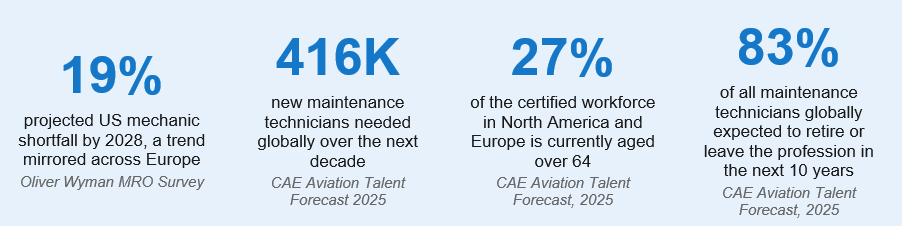
The freelance trend is not the cause of Europe’s maintenance workforce crisis. Itis its most visible symptom. The underlying pressures have been building for years.
Achieving a full EASA Part-66 Type-Rated Licence takes between five and seven years, demands significant personal financial investment, and has historically resulted in entry-level salaries at the bottom of the engineering pay scale.[3] Meanwhile, the industry has been slow to address fatigue, burnout, and the toll of irregular shift patterns on long-term retention.
At MRO Europe 2025, B1 and B2 certified engineers were described as “the hardest roles to fill” across the entire sector. [4] Retirement is accelerating the problem further: with nearly a third of the certified workforce now aged over 64, the next six years will see a wave of departures that no short-term recruitment campaign can offset. [5]
"We must fight like hell on the international market to get the best talents." - Thierry Baril, Chief Human Resources Officer, Airbus
Labour cost inflation reached 7.3% in 2024, with forward wage agreements pointing to a further 5.8% annual increase, squeezing MRO margins already under pressure from fixed-price power-by-the-hour contracts. [6]
Behind the workforce numbers lies a regulatory reality that the industry is only beginning to reckon with. A certifying engineer’s signature on a release to service is not a formality. It is a legal declaration of airworthiness, backed by their personal licence. The weight of that responsibility has always been significant. What has changed is that engineers now have the leverage to price it accordingly.
Unlike flight crew, licensed maintenance engineers are not subject to hard regulatory limits on hours worked. EASA’s Acceptable Means of Compliance reference fatiguerisk management in AMC1 145.A.47(b), but there is a documented gap between what the framework requires on paper and what happens at 3am during an AOG event.[7]
Industry experts have called for EASA Part-145 to be updated to extend pilot-equivalent duty-hour limits and Fatigue Risk Management System requirements to maintenance organisations, arguing that the root cause of the retention crisis is the industry’s treatment of maintenance engineering as a cost to be minimised rather than a capability to be invested in. [3]
There is a second dimension to this crisis that rarely makes it into industry reports, and it is one of the most revealing. Some of the largest operators in Europe carry a substantial, sustained need for staffing, yet they cannot turn to the contractor market at all. Collective labour agreements and union frameworks in several European countries restrict or prohibit the use of independent contractors for core maintenance roles. These organisations are left with one option: hire permanent employees, or hire no one.
In principle, this should make permanent recruitment easier: a captive demand for full-time positions with no contractor competition for the role. In practice, the opposite happens. We recently ran an experiment with exactly this kind of client, posting genuine permanent engineering positions into the market. The result was stark: zero applications. Licensed engineers, the very people these roles were designed for, showed no interest at all.
The reason is not simply a matter of headline earnings. While contract work can often provide higher gross remuneration, the decision to operate as a freelance engineer is driven by a broader set of factors, including individual tax circumstances, social security obligations, and the regulatory framework of the engineer’s country of residence. Direct income comparisons between permanent and freelance roles therefore rarely tell the full story.
What attracts many licensed, type-rated engineers to freelance work is the ability to exercise greater control over their professional lives. Contracting offers flexibility in choosing assignments, managing working patterns, determining periods of availability, and taking direct responsibility for one’s own career and income. For many experienced engineers, this autonomy has become as important as financial considerations.
The result is a structural deadlock. On one side, labour frameworks restrict airlines and MROs from accessing a significant portion of the qualified contractor workforce that already supports much of the market. On the other, permanent positions often fail to offer the flexibility, independence, and professional control that many licensed engineers have deliberately chosen. The consequence is a system that limits access to highly qualified personnel for many of Europe’s important operators, while providing little incentive for experienced engineers to return to traditional employment models.
The practical impact is already visible. Maintenance companies across Europe are reporting delays, difficulties filling critical B1 and B2 positions, and growing dependence on temporary contractors to cover gaps that were once staffed by permanent employees. [8] Airlines, meanwhile, continue expanding their fleets and increasing utilisation, placing further pressure on a technical workforce that is simultaneously shrinking and redistributing itself into the contractor market.
MROs that have responded by simply pushing for more output from already stretched teams are finding that this accelerates, rather than resolves, the problem. The engineers who remain in permanent roles increasingly have one foot out the door, watching their former colleagues earn materially more with greater schedule control. [2]
The organisations navigating this most effectively are those that have moved early: offering hybrid working arrangements, transparent pay structures, and flexibility that competes, at least partially, with what the contract market offers.
Since 2019, STAFFHUBAERO has operated at exactly this intersection: connecting MROs and airlines with certified aviation professionals, including B1/B2 engineers, NDT technicians, structural specialists, and maintenance crews, at the speed that modern operations demand.
The trend described in this article is not abstract for us. We see it in every client conversation. The organisations calling us are not doing so because they want to rely on contractors. Many would strongly prefer stable, permanent teams. They are calling because the market has moved, and their operational continuity depends on adapting to it.
Our role is to provide support carefully structured to meet the unique needs of each client and partner. Not as a long-term substitute for workforce investment, but as the bridge that keeps aircraft flying while the industry works through a structural challenge a decade in the making.
Need certified B1/B2 engineers ormaintenance specialists?
staffhubaero.com/contact | admin@staffhubaero.com | +35722 270051
References
1. Aviathrust: Why Aircraft MaintenanceEngineers Are Leaving Europe (March 2026)
2. Aviation Job Search: Inside the AircraftEngineer Shortage in Europe (October 2025)
3. Aviathrust: EASA Part-66 Training Pathwayand Structural Workforce Issues (March 2026)
6. Mordor Intelligence / Oliver Wyman:Europe Aircraft MRO Market Report (2026)
7. Online Aviation Training: The Licence,the Signature, and the Gap Nobody Talks About (April 2026)
8. AeroProfessional: Aircraft Engineer andTechnician Shortage 2025 (October 2025)

Aviation services, including team organisation, technical support and operational solutions for airlines and MROs worldwide. Based in Europe and the UK, operating globally since 2019.


.jpg)